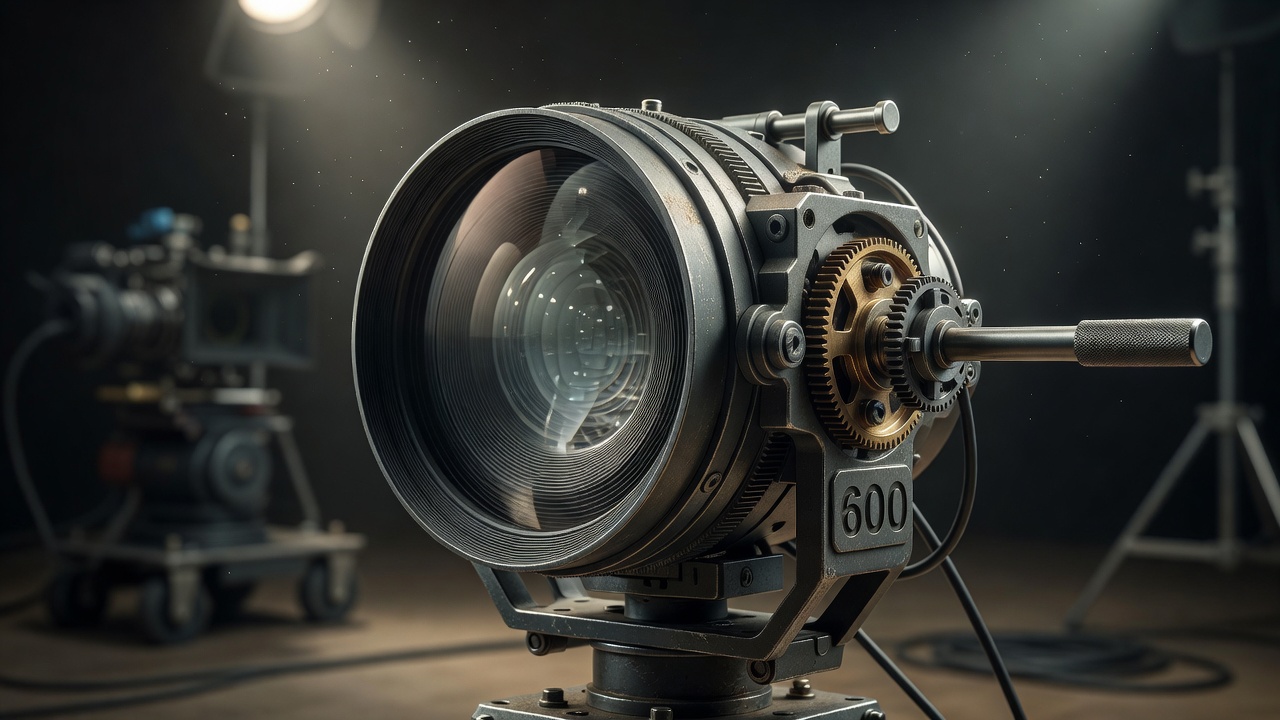
The Optical Principle of the Stepped Fresnel Lens
Originally devised by French physicist Augustin-Jean Fresnel in the early nineteenth century for maritime lighthouses, the Fresnel lens reduces the physical mass and volume of a thick plano-convex lens by segmenting its curvature into a series of concentric annular rings. In studio cinematography and theatrical stages, this optical geometry offers an unparalleled balance of high optical transmittance, manageable weight, and precise beam divergence.
Unlike raw open-face reflectors that throw uneven hot spots with scattered fringe halos, a Fresnel lens gathers light from the emitter and a spherical back-reflector, transforming diverging rays into an intensely collimated, clean beam. The defining visual characteristic is its crisp shadow transition: shadows cast by objects in front of a Fresnel spotlight remain razor-sharp near the subject while feathering subtly and uniformly with distance.
Spot-to-Flood Mechanical Operation
Beam adjustment inside a Fresnel fixture relies on altering the physical distance between the primary light source (a high-density COB LED chip or traditional tungsten/HMI filament) and the fixed borosilicate front lens:
- The Spot Setting: By turning the focus crank to translate the light engine toward the focal point of the lens, the outgoing light rays become nearly parallel. This yields maximum central beam lux, tight beam angles (typically 12° to 15°), and extended throw distances ideal for simulating intense sunlight through windows or isolating performers on dark stages.
- The Flood Setting: Advancing the emitter closer to the glass element causes the light cone to diverge broadly (up to 50°–55°). This reduces central intensity but blankets a wider perimeter with uniform illuminance and smooth edge roll-off.
In high-power continuous fixtures exceeding 600W, focal plane temperatures at the lens can surpass 180°C. Professional Fresnel housings employ shock-resistant borosilicate glass with low thermal expansion coefficients. While molded optical acrylics offer lightweight convenience on compact battery units, high-temperature borosilicate prevents internal chromatic aberration, melting, or optical clouding over years of continuous grid operation.
Performance Matrix: Spotlight Throw Ratios
| Wattage Class & Engine | Lens Diameter | Spot Lux @ 5 Meters | Flood Lux @ 5 Meters |
|---|---|---|---|
| 300W Bi-Color COB | 175mm (7 inch) | ~8,900 Lux (15°) | ~2,100 Lux (45°) |
| 600W Daylight COB | 250mm (10 inch) | ~24,500 Lux (12°) | ~5,400 Lux (50°) |
| 1200W Daylight COB | 350mm (14 inch) | ~58,000 Lux (11°) | ~12,800 Lux (55°) |
Barndoor Precision and Shaping Accessories
Because the Fresnel lens creates an orderly, collimated wavefront, external 8-leaf or 4-leaf rotating barndoors bite cleanly into the light field. Gaffers can cut light off background walls, prevent lens flares directly into the camera matte box, or create narrow vertical slits without the ragged spill associated with standard reflector dishes.
Modern motorized Fresnel units also integrate motorized focus sliders controllable via wired DMX512 or wireless CRMX (LumenRadio), enabling console operators to shift beam spreads on suspended lighting pipe grids without manual ladder intervention during filming.