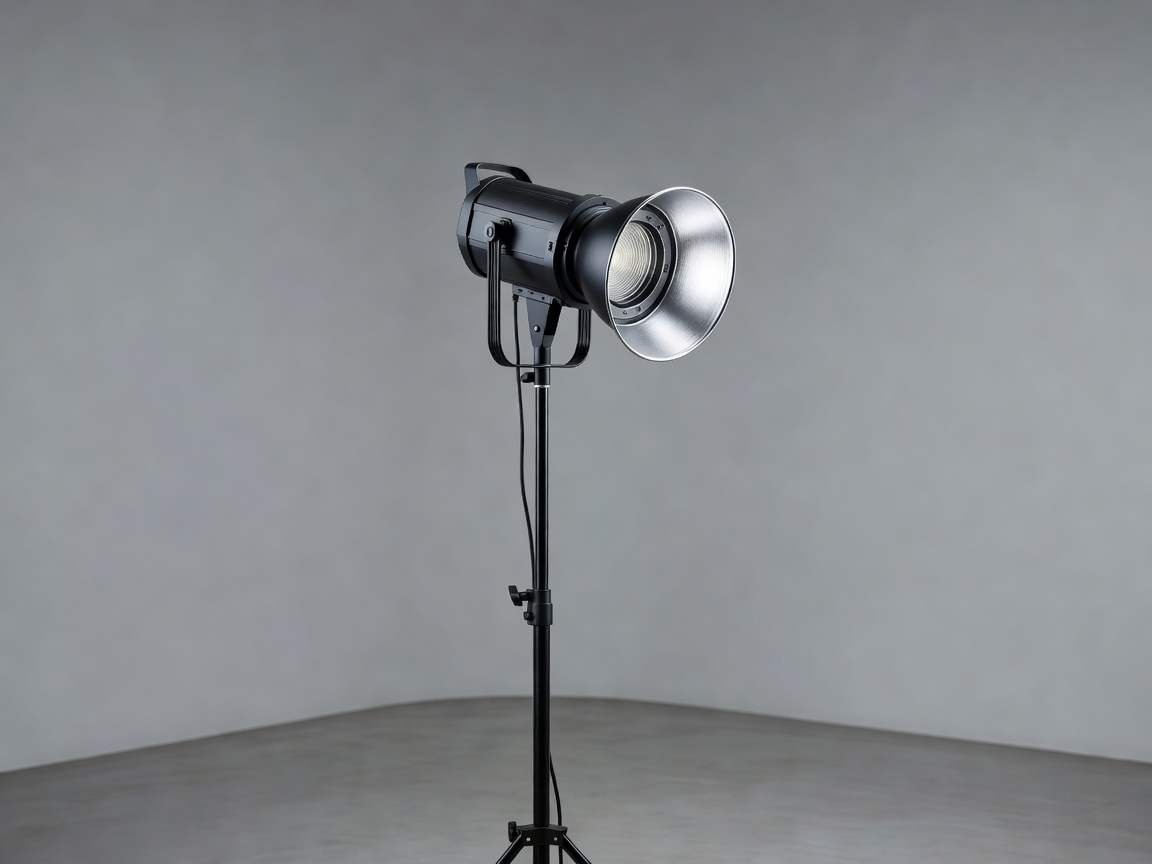
The Mechanics of Modern Monolight Systems
Studio monolights stand as the bedrock of commercial still photography, high-end fashion shoots, and frozen-motion advertising campaigns. Unlike pack-and-head generator configurations that house heavy capacitor reservoirs on the floor with umbilical power cabling running up to the head, a self-contained monolight incorporates its own power supply, triggering logic, cooling fans, and flash discharge tubes into a single unified housing.
Contemporary monolights have migrated predominantly toward Insulated Gate Bipolar Transistor (IGBT) circuitry. This architecture enables precise microsecond truncation of the discharge pulse. Where older analog strobes governed output solely by varying the primary capacitor voltage—which severely prolonged flash duration at lower power settings—IGBT units digitally cut off the flash curve sharply. This produces t0.1 flash durations as rapid as 1/20,000 second, freezing liquid splashes, falling powder, and ballistic motion with zero edge blur.
Photometric Ratings & Flash Duration (t0.5 vs t0.1)
When evaluating monolights, photographic technicians must distinguish between t0.5 and t0.1 rating standards:
- t0.5 Measurement: Represents the time span during which flash output remains above 50% of peak intensity. While commonly listed in marketing materials because of its lower nominal figure, t0.5 discards the long descending "tail" of the flash pulse, which frequently produces ghosting artifacts in high-speed captures.
- t0.1 Measurement: Measures the entire discharge period down to 10% of peak output. This represents approximately 90% of total emitted photons and provides a true benchmark for motion-stopping performance on camera sensors.
A primary challenge in high-end flash architecture is color temperature shift. When strobes drop power from full dump (1/1) to minimum output (1/256), the Kelvin rating can fluctuate by up to 800K if uncontrolled. High-grade digital strobes feature dedicated "Color Freeze" or "Stable CCT" modes, holding correlated color temperature within ±50K through precision capacitor pulse tailoring.
Technical Comparison: Common Monolight Output Classes
| Watt-Second Class | Typical Guide No. (ISO 100) | Full Dump Recycle | Optimal Studio Application |
|---|---|---|---|
| 300 Ws – 400 Ws | GN 60 – 65m | 0.5s – 0.9s | Headshots, tabletop product sets, compact studios |
| 600 Ws | GN 80 – 87m | 0.8s – 1.2s | Full-body fashion, large octabox keys, corporate group portraits |
| 1200 Ws | GN 110 – 120m | 1.4s – 1.8s | Outdoor sun-overpowering, automotive studios, multi-diffusion rigs |
Thermal Dissipation and Modeling Lamp Evolution
Sustained continuous burst firing generates intense thermal loads inside flash housing. Aluminum chassis enclosures paired with active, temperature-sensing fan governors prevent premature capacitor degradation. Modern monolights have also retired traditional 250W halogen modeling bulbs in favor of high-CRI chip-on-board (COB) LEDs rated between 30W and 60W. These solid-state modeling arrays run significantly cooler, consume nominal idle power, and output proportional luminance that closely mirrors the ambient strobe contribution.
Triggering Protocols and Bowens Mounting Ecosystem
Integrated 2.4GHz multi-channel wireless receivers now come standard, supporting high-speed sync (HSS) up to 1/8000 second shutter speeds across all major camera manufacturer trigger profiles. On the front facet, the standard Bowens S-Type bayonet remains the dominant standard, facilitating frictionless attachment of parabolic reflectors, beauty dishes, and strip banks without proprietary mounting friction rings.