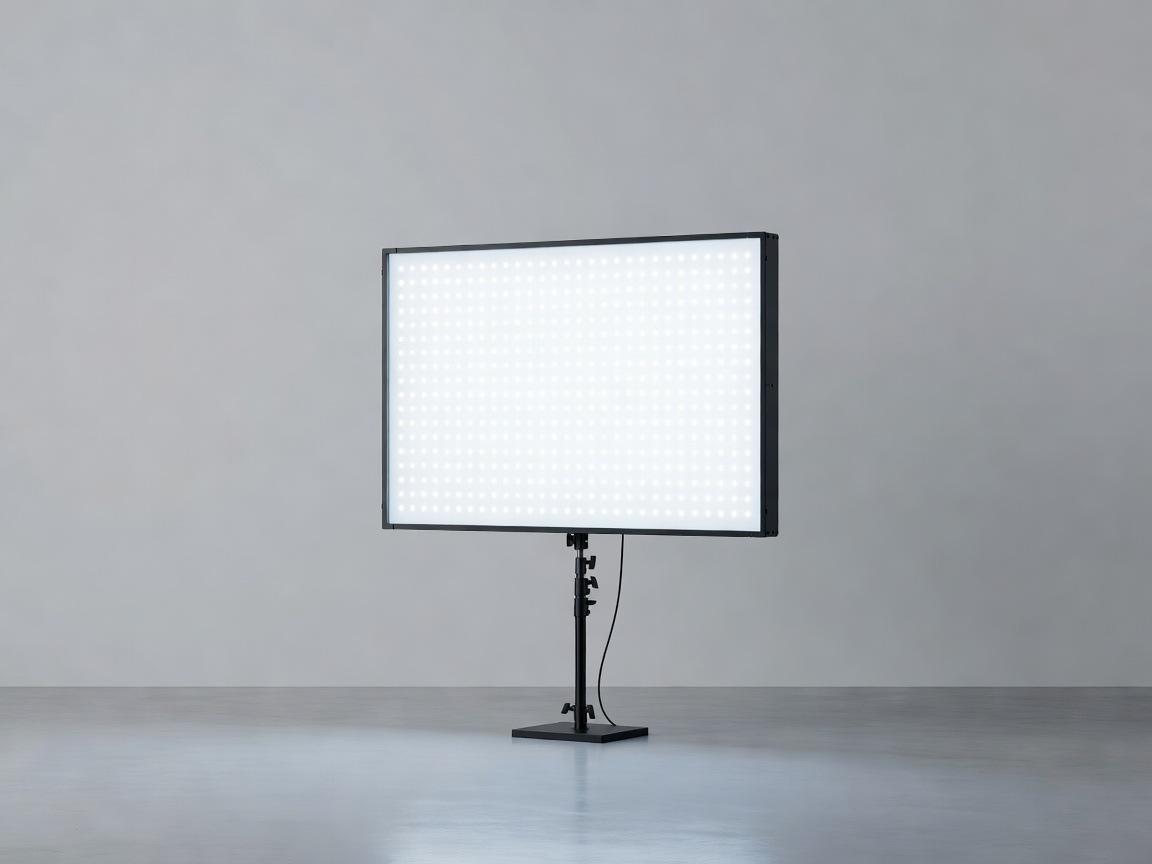
The Architecture of Modern Continuous Soft Fixtures
The transition from fluorescent bank units (such as multi-tube Kino Flo systems) to solid-state LED panels transformed cinematic production workflows, corporate interview sets, and broadcast newsrooms. LED panel fixtures fall into two primary mechanical topologies: direct-view Surface-Mount Device (SMD) arrays and edge-lit light guide plates.
Direct-view matrices place hundreds of discrete bi-color or multi-emitter diodes across an expansive aluminum backplate, backed by interchangeable diffusion panels. This delivers intense forward throw and high foot-candle efficiency. Conversely, edge-lit panels inject photons along the perimeter of an etched acrylic dispersion slab, yielding an extraordinarily smooth, micro-diffused source that prevents specular multi-shadow artifacts on human skin, even when mounted in close proximity without supplemental diffusion fabrics.
Spectral Metrics: Understanding TM-30-18, CRI, and TLCI
While standard Color Rendering Index (CRI Ra) calculates fidelity across eight pastels, modern cinematography demands rigorous assessment under the Television Lighting Consistency Index (TLCI) and IES TM-30-18 methods:
- R9 Saturated Red Rendering: Traditional white phosphor LEDs often lack deep red spectral energy (660nm). High-tier LED panels consistently yield R9 values greater than 92, ensuring natural capillary skin tones without muddy brownish shifts.
- TLCI Standard: Specifically calculates how a standard 3-CCD broadcast camera sensor interprets spectrum. Premium LED panel fixtures achieve TLCI scores of 98 to 99, drastically decreasing post-production color grading overhead.
- Fidelity (Rf) and Gamut (Rg): TM-30-18 maps 99 real-world color samples, validating that skin pigments, fabrics, and backdrop tones remain distortion-free across varying ambient levels.
To avoid high-speed shutter banding or rolling-shutter artifacts during 240fps or 1000fps capture, studio panels employ ultra-high-frequency PWM drivers operating above 25kHz. Dimming options typically include Linear, Logarithmic, Exponential, and S-Curve profiles, providing granular control down to 0.1% power output without color Kelvin drift.
Structural Considerations: Form Factor Comparison
| Panel Form Factor | Average Power Consumption | Weight & Rigging Footprint | Typical Production Use Case |
|---|---|---|---|
| 1x1 (30cm x 30cm) | 100W – 150W | 3.5kg – 4.5kg / 16mm Baby Pin | Documentary run-and-gun, rim/kicker light, overhead hair light |
| 2x1 (60cm x 30cm) | 200W – 350W | 7.0kg – 10.5kg / 28mm Junior Pin | Primary key light for two-person interviews, news anchor desks |
| 4x2 / 4x4 Large Format | 600W – 1200W | 18kg – 25kg / Heavy Duty Junior Combo | Broadcast soundstages, high-key cycloramas, feature films |
Thermal Management and Power Delivery
In sensitive audio recording environments, sound engineers cannot tolerate acoustic fan noise. Leading broadcast panels employ oversized extruded aluminum heat sinks that facilitate passive, fanless cooling up to 150W outputs. Larger units above 300W utilize decoupled, magnetically levitated bearing fans that operate below 18 dBA at 1 meter, or provide software modes that switch to silent convection at slightly reduced lumen ceilings.
Power distribution options are tailored for flexibility: dual V-Mount or Gold-Mount battery plates accommodate 14.8V to 26V high-draw cine batteries on location, while universal AC switching power bricks handle 100V–240V 50/60Hz mains power on soundstage grids.