The Inverse-Square Law and Apparent Source Size
In photographic and motion picture lighting, the apparent softness or hardness of an illuminated subject is governed not by the raw power of the fixture, but by the relative physical size of the light source compared to the distance of the subject. A tiny, intense COB emitter placed two meters away acts as an uncompromising hard point source, producing harsh pore textures and deep specular shadows.
By enclosing that same emitter within a 120cm or 150cm octagonal softbox, the emitting surface area expands exponentially. Light rays now strike the subject from a myriad of divergent angles simultaneously, wrapping around facial contours, softening specular transitions, and creating an expansive, flattering catchlight in the human eye.
Geometric Formats: Parabolic, Strip, Octabank, and Lantern
Selecting the appropriate modifier geometry dictates beam focus, wrap gradient, and background containment:
- Deep Parabolic Softboxes: Characterized by extended depth and 16 or more flexible steel rods, parabolic domes collimate light forward while still retaining soft edge falloff. With an internal silver reflective lining, they produce punchy contrast with high center luminance.
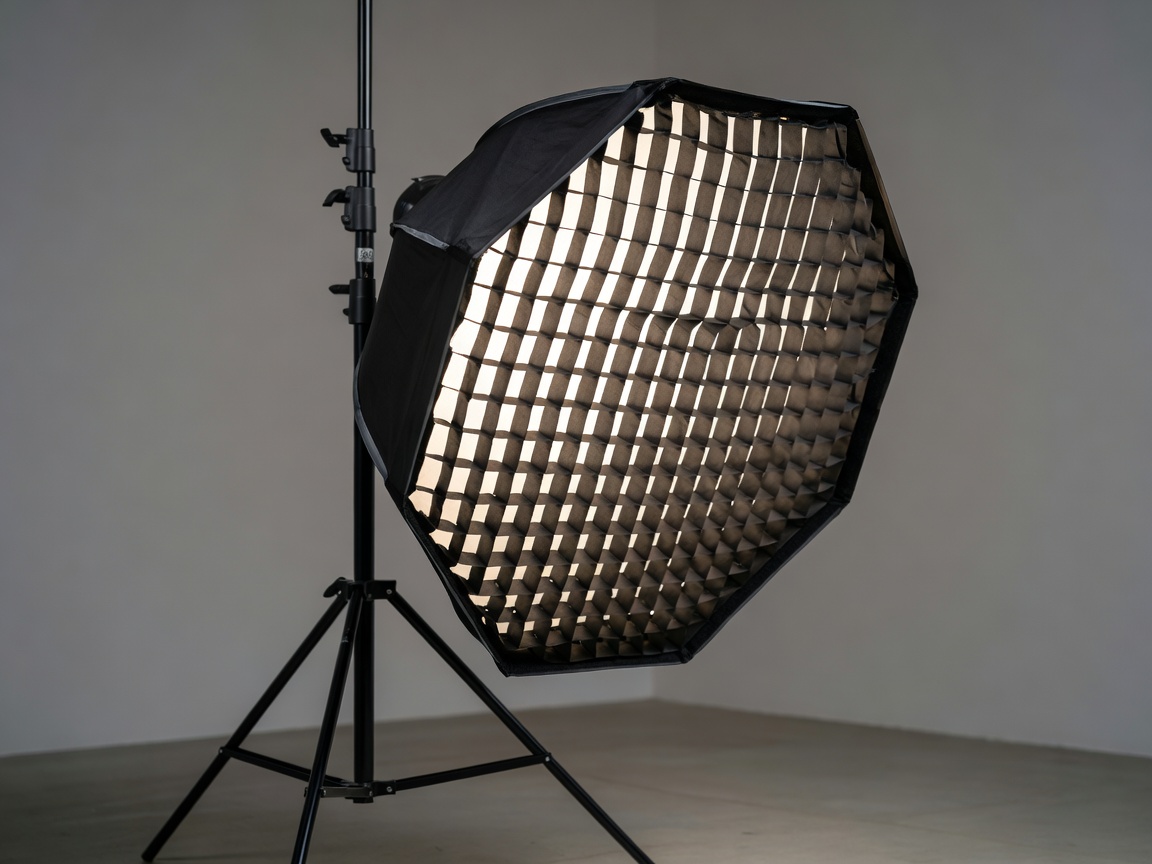
- Octabanks (Octagonal): Mimic circular geometry, creating rounded eye reflections preferred for commercial beauty portraits and interview key lights.
- Strip Boxes (1:3 or 1:4 aspect ratio): Long, slender softboxes ideal for edge lighting full-length human figures or creating clean, linear specular reflections along glossy glassware and automotive metalwork.
- Lantern & China Ball Diffusers: Spherical fabric shells that cast uncollimated 360-degree soft illumination, serving as ambient ceiling fill for narrative interior scenes.
Professional modifiers incorporate an interior floating baffle in conjunction with an exterior front diffuser sheet. The inner baffle neutralizes the intense forward optical cone ("hot spot") directly facing the bulb, redistributing photons toward the perimeter walls. This ensures that the outward-facing front diffusion sheet glows with absolute photometric uniformity from corner to corner.
Grid Engineering: Directional Spill Containment
| Grid Beam Angle | Spill Reduction Level | Luminance Loss (Stops) | Recommended Set Scenario |
|---|---|---|---|
| 50° Wide Grid | Moderate Spill Cut | ~0.3 – 0.5 EV | Open studio spaces, broad portraiture, gentle falloff |
| 40° Standard Grid | High Spill Cut | ~0.7 – 1.0 EV | Moody interview lighting, separating subject from dark backdrop |
| 30° Narrow Grid | Extreme Collimation | ~1.3 – 1.6 EV | High-contrast rim lighting, dramatic chiaroscuro cinematography |
Fabric Materials: Silk, Ripstop, and Heat Ratings
Light modifier fabrics must endure sustained exposure to intense heat while maintaining neutral spectral transmission. Non-yellowing woven nylon and polyester textiles undergo optical calibration to prevent magenta or green shifts. When pairing modifiers with powerful continuous lights (such as 600W or 1200W COB units), technicians specify high-temperature rated speedrings with ventilation ports to avert fabric scorching and heat buildup inside the rear housing.
Quick-release umbrella-style tension mechanisms have rapidly superseded traditional speedrings requiring individual rod insertion, shaving setup times on location from ten minutes down to seconds while safeguarding fabric tension throughout long productions.