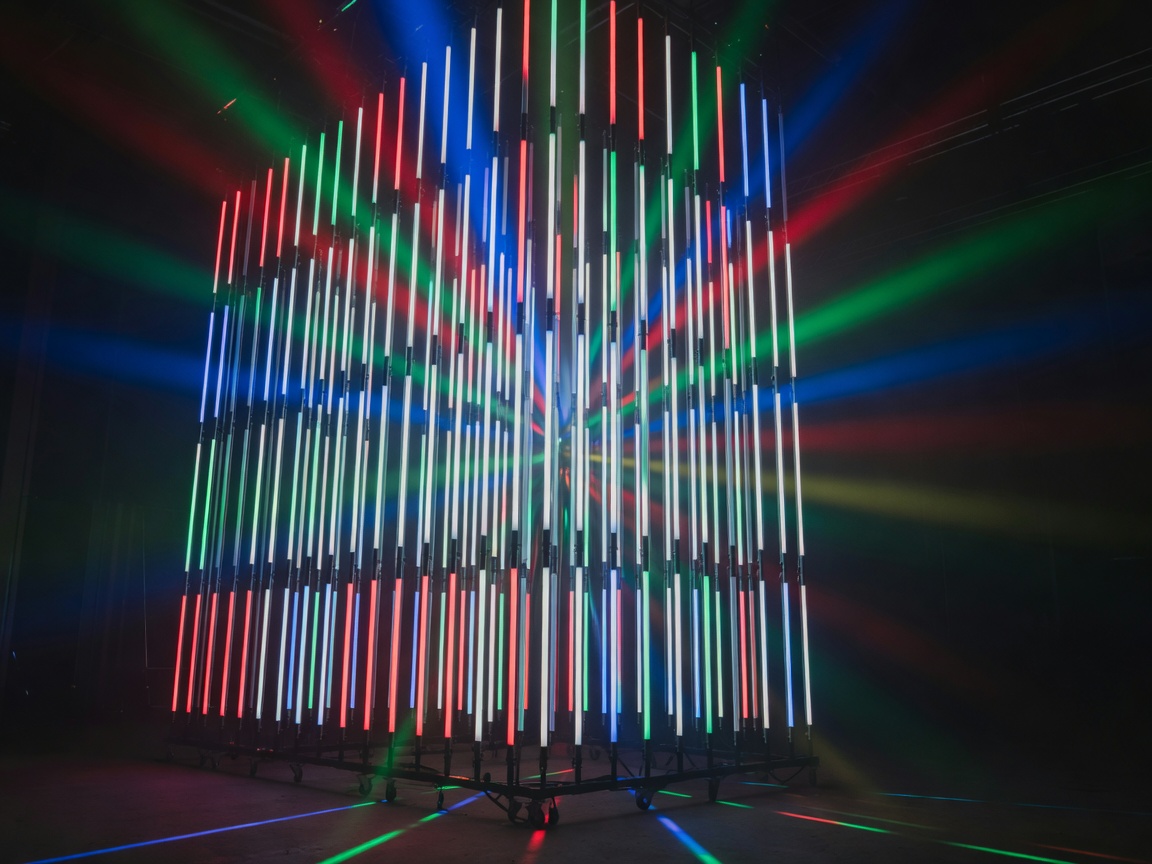
The Five-Color Diode Architecture: Beyond Standard RGB
Linear tube fixtures have revolutionized music video aesthetics, vehicle interior rigs, and sci-fi narrative production. Early iterations utilized three-color RGB emitters, which suffered severe spectral deficiencies: mixing red, green, and blue to produce nominal white light created spiky spectral power distributions with heavy green spikes and hollow cyan gaps, resulting in sickly skin tones on digital cinema cameras.
Modern cine-grade tubes incorporate an RGBWW or RGBACL array. By pairing high-purity red, green, and blue emitters with dedicated warm-white (typically 2700K) and cool-white (typically 6500K) phosphored diodes, the fixture generates broad, continuous spectral emissions across the visible wavelength range from 380nm to 780nm. As a result, CCT can be calibrated seamlessly between 2000K (candlelight amber) up to 10,000K (deep twilight blue) with full green/magenta tint adjustment.
Pixel Mapping and Addressable Zones
A major advantage of continuous linear tubes is addressable pixel mapping. Rather than illuminating the tube as a single homogenous block of color, internal microcontroller arrays divide the cylinder into independently controllable zones:
- 8-Zone to 16-Zone Modules: Standard 4-foot tubes feature 16 individually addressable pixels, enabling fluid visual effects such as moving fire embers, emergency vehicle strobes, television screen bounce, and flowing chromatic chases.
- Low-Latency Art-Net Streaming: In virtual production environments and LED volume stages, pixel-mapped tubes receive real-time lighting cues synchronized with unreal engine camera frustums, matching reflections across vehicle windshields and talent eye catchlights in real time.
Cine tubes feature built-in high-capacity lithium-ion cells capable of providing up to 2 hours of continuous operation at 100% full RGB brightness, or 10 to 18 hours at nominal ambient fill levels. Advanced firmware provides a "Target Runtime" governor: entering a desired call-sheet duration (e.g., 6 hours) automatically caps output luminance to guarantee continuous operation without sudden mid-take power loss.
Structural Specifications Across Standard Lengths
| Length Classification | Average Power Draw | Addressable Zones | Weight & Mounting Options |
|---|---|---|---|
| 2-Foot Tube (approx. 60cm) | 25W – 30W | 8 Pixels | 0.8kg / Magnetic clips, 1/4"-20 eyelets |
| 4-Foot Tube (approx. 120cm) | 48W – 60W | 16 Pixels | 1.4kg / Dual T12 clips, cross-bracket rigs |
| 8-Foot Tube (approx. 240cm) | 100W – 120W | 32 Pixels | 2.9kg / Heavy-duty baby pin tube holders |
Mounting Modularity: T12 Standard and In-Scene Practicals
Tubes adopt the classic T12 outer diameter (1.5 inches / 38mm), guaranteeing immediate backward-compatibility with decades of grip hardware, including standard fluorescent mounting clips, Kino Flo shells, and spider brackets. Furthermore, their diffused polycarbonate casing is shatter-resistant and creates a smooth 180° to 220° beam angle.
Because the tube housing is visually attractive and contains no protruding bulky fans, cinematographers frequently mount them directly inside the frame as practical set decoration—embedded into walls, suspended beneath industrial catwalks, or built into neon-lit storefront props.